The Paper Crown and the Small Bang: How the Cracker Became Christmas
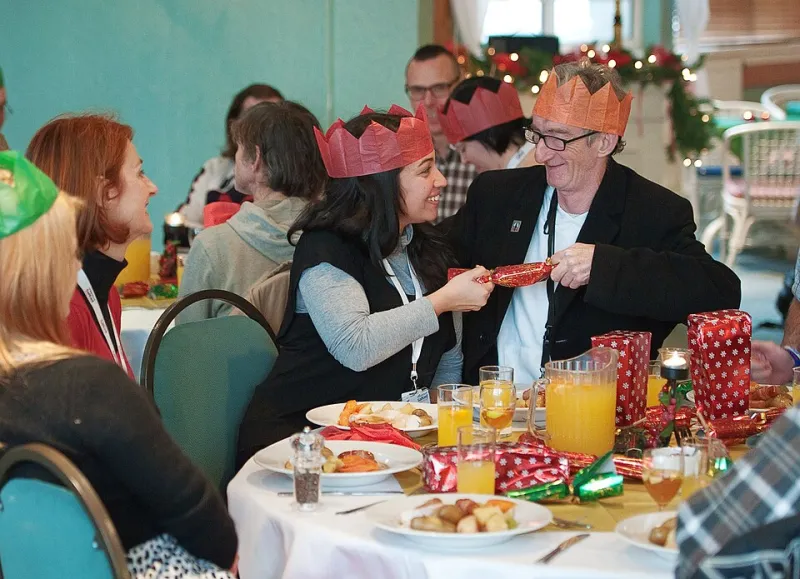
Photo: University of Salford Press Office, CC BY 2.0, via Wikimedia Commons
The Christmas cracker is a deeply silly object. It is a cardboard tube containing a paper hat, a plastic frog and a joke that has never been funny. It makes a noise. It creates waste. And yet, on the right table, at the right moment, it is also the most reliable piece of theatre in the British winter. You pull, it bangs, someone wears a crown, someone reads out a pun, and for a second the table is united in mild embarrassment. That is not nothing.
A London sweet shop and a French idea
The cracker began in the 1840s with Tom Smith, a London confectioner who sold bonbons wrapped in twisted paper. On a trip to Paris he saw sugared almonds wrapped in similar paper, and he brought the idea home. In 1847 he began selling his own version: a small paper package containing a sweet, with a motto or a riddle inside. The pleasure was in the unwrapping. The problem was that the unwrapping was quiet.
Smith's sons, or Smith himself depending on which account you trust, added the snap. A small strip of paper impregnated with silver fulminate, pulled apart by friction, made a satisfying crack. The cracker became a small event. By the 1860s, the noise was the point. The sweet was almost incidental. Later came the paper crown, the trinket and the joke. By the early twentieth century, the cracker had settled into the form we know: a tube, a bang, a hat, a gift, a groan.
The paper crown and the small bang
The crown is the cracker's masterstroke. It is cheap, it is universal and it makes everyone look ridiculous in the same way. At a formal dinner, the paper crown is a small act of rebellion against the table settings. At a family lunch, it is a leveller. The joke is the same: a pun, a riddle, a sentence that barely qualifies as a joke. The gift is usually a tiny plastic thing that will be lost by Boxing Day. None of this is the point. The point is the ritual.
Why the silly thing still matters
In a curated celebration, the cracker is a useful reminder that not everything has to be beautiful. The Roseline believes in considered tables, proper napkins and candles that have been lit with intention. But a table without a cracker can feel a little too much like a shop window. The cracker introduces chaos, and chaos is what makes a room feel lived in. It also gives people something to do with their hands while the sprouts are being passed.
There is a practical argument, too. The cracker is a shared activity. It requires two people. It requires a small amount of trust. It produces a noise that makes everyone laugh or wince. In a season full of passive entertainment — the television special, the playlist, the film — the cracker asks for participation. That is worth something.
Choosing a considered cracker
If you are going to have crackers on the table, choose them properly. The supermarket multipack is fine for an office lunch, but for a Christmas Eve table or a small family dinner, look for crackers that do not feel disposable. Independent stationers, museum shops and small UK makers produce crackers with better jokes, useful gifts and paper that can be recycled. Look for FSC-certified card, paper hats that are actually paper, and gifts that will not end up in a drawer. Some makers offer refillable crackers, which is a small step in the right direction.
Avoid crackers with plastic toys that break immediately. Avoid crackers that are more than £50 for six unless you are making a statement. Avoid crackers with jokes about mothers-in-law. The best crackers are the ones that make everyone groan in unison, not the ones that make one person feel small.
Making your own
The homemade cracker is a lovely thing, but it is also a faff. You need cardboard tubes, cracker snaps, tissue paper, ribbon and a small gift. The snaps are available from craft shops. The gift should be useful or funny: a good chocolate, a tiny jam, a lottery ticket, a handwritten note. The joke should be terrible on purpose. The crown can be cut from tissue paper. The whole thing takes about an hour for six crackers, which is either a pleasant afternoon or an unnecessary stress, depending on your temperament.
If you make them, make them with someone. The point is not the cracker. The point is the sitting down together.
This Christmas, pull a cracker. Wear the hat. Read the joke. Groan. It is a small, silly, deeply British ritual, and it is worth keeping.